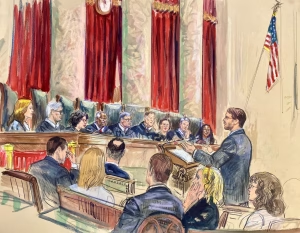
On Tuesday, January 13 2026, the Supreme Court in Washington held a historic oral argument over the state banning of transgender Athletes in Women & Girl’s sports. The debates revolved two cases, West Virginia v. BPJ and Little v. Hecox , which focused on two female transgender athletes, who have been forcefully barred by Virginia and Idaho state laws from participating in sporting events on girls’ and womens’ teams due to their gender identity. Lambda Legal, the American Civil Rights Liberties Union (ACLU), and Legal Voice were the civil rights organizations which filed the complaints and challenges. The main argument that was offered by the athletes attorneys was that the ban violates the rights held by transgender individuals, and that it is also in direct violation of Title IX, the federal law that prohibits discrimination based on sex in sporting.
Joshua Block, Senior Counsel for the ACLU’s LGBTQ & HIV Project, stated that, “This case is about the ability of transgender youth like Becky to participate in our schools and communities.” Betty Pepper-Jackson, the fifteen year old athlete of Bridgepoint, West Virginia, also offered her stance on what they are fighting for. “I play for my school for the same reason other kids on my track team do–to make friends, have fun, and challenge myself through practice and teamwork,” also expressing that her treatment was, “. . .unfair to me and every transgender kid who just wants the freedom to be themselves.”
The second case is that of Little v. Hecox, which was filed by Lindsay Hecox, now aged 24, in protest to Idaho’s 2020 law known as, “Fairness in Women’s Sports Act,” the first act in the history of the US that prohibits transgender women from competing on women’s teams–from elementary school all the way through college.
Since the first Ban in 2020, 27 states have emitted state laws that prevent trans youths from participating in their school’s extracurricular activities. These bans not only prevent their participation but also allows for invasive variations of “sex testing” on these students. A few examples of such treatment include a case in Florida, where a 15-year-old girl on the junior varsity volleyball team was the subject of a police investigation revolving around her assigned sex based off on anonymous accusation. In Utah, a teen-aged basketball player was accused of being transgender by a member of her own school board, and was forced to be subject of threats of violence against both her and her family.
Oppositely, the opposing forces that represent the states of Idaho and West Virginia include Governor Brad Little, Boise State University, Idaho state officials, The State of West Virginia, West Virginia Solicitor General Michael Williams, and Attorney General John McCuskey. In defense of the law, Idaho tells justices that, “. . .[n]one of the Act’s operative provisions classify based on whether someone identifies as transgender.” Meaning that the legislature was made not to be discriminatory, but instead to allow fairness and safety to rule supreme in the female spaces.
West Virginia similarly expressed that same sentiment in brief, stating that their law, “implicates ‘fierce scientific and policy debates’ that elected legislators are best able to resolve,” also expressing that,”sex is generally irrelevant. But Title IX governs education, where biological differences are critical to athletic fairness. The Act designates sports based on biological sex—exactly what Title IX permits.”
While the final decision of the Supreme Court on the constitutionality of the Acts is still to be determined, a SCOTUSblog article offers the insight that it appears the Court will rule in the favor of Idaho and West Virgina.
ERHS Freshman, Greyson Maliski, offered his opinion, stressing that, “The girls should be allowed in sports if they have been on HRT for years.”