
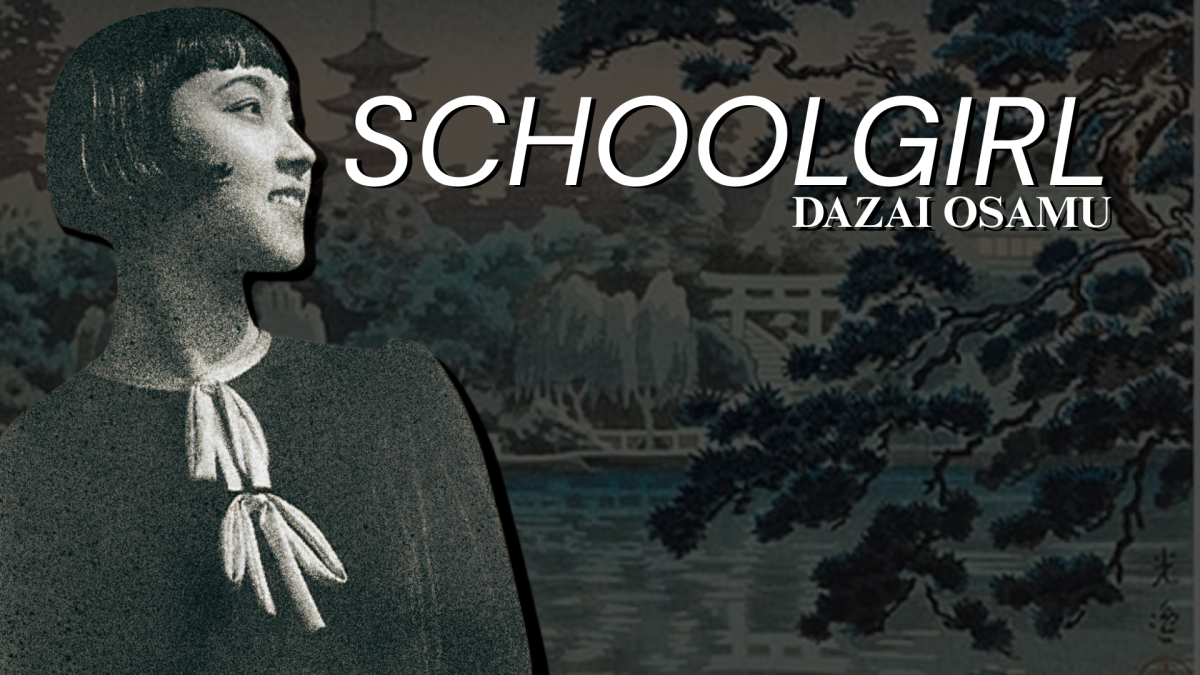
In the world of Dazai Osamu, it is impossible for those familiar with his life to forget that the works he constructed were often reflections of his own mind, thoughts, and struggles. The short story, “Schoolgirl,” is no exception, but certainly deserves to stand out among his collection of literary creations as not an account of Dazai, but one that holds the account of a young girl, who’s existence above all reflects the time she was living in, and how she coped with it.
“Schoolgirl” was the very first book written by Dazai that I ever read, and I was skeptical to believe that she would go on to be anything more than the typical sympathetic, “sad-girl” stereotype, with nothing much else to her character. However, as the book goes on, the schoolgirl is shown to be much more than a simple caricature of teenage girls created by an adult man. In a stream of conscious thoughts, we follow the girl in the span of one day, and are given an in-depth view of how she grapples with her life in 1930’s Tokyo, and how it mirrors her country’s ongoing descent into fascism. The loss of her father, pressures of conformity, and longing of rebellion, but finding herself trapped in a society that prevents her from doing so.
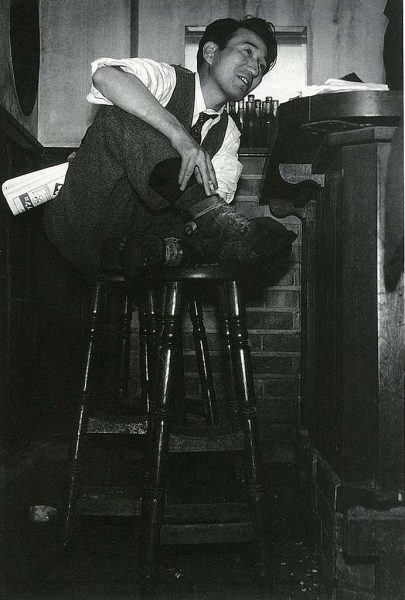
Life for young girls in pre-war Japan was marked by the state-promoted ideal of “Ryōsai Kenbo:” Good Wife, Wise Mother. A patriarchal system embedded into Japanese society, that put extreme emphasis on traits of compliance, domestic skills, and service to the family and nation. Girls in this time were largely defined by their predetermined lives as wives and mothers, and so it was only natural for Dazai to include this as a reoccurring theme in his story, and a source of despair for the Schoolgirl. Not simply because she necessarily disagrees with the heavily normalized mindset, but because she believes she can never live up to it. The story highlights the performative nature of social interactions and expectations in general, which she both participates in and is alienated by. The Schoolgirl is a ghost in her world, and rebels only internally, through silent mocks of adults in her head, and uncertainty as to how her life will unfold. Above all, she longs for structure, but not one that the life of a perfect, plastic life of a wife would give her, and instead one of authenticity, which would be nearly impossible to find in her society.
The Schoolgirl’s view of women in general, is portrayed as what would no doubt be called misogynistic in today’s world. She goes as far as to discuss a woman on the train she did not know in violent ways, remarking that “. . . the dark wrinkles on her neck and coarseness made me want to hit her in disgust,” and then later saying that she was “all too familiar with the impurity found in women.” Whether or not this was Dazai’s own opinions put into fiction, or a consciously chosen character trait he gave to her is up to interpretation, but in one’s own view it was clear that her words were hypocritical in their own sense.
The protagonist is quick to condemn and berate women she does not know, and yet is acutely aware of her own flaws. This conflict stems from her consistently addressed desire to be a beautiful woman, a good student and daughter, who fits into her world. It is also what catches most readers off-guard, and even causes them to condemn the work as a piece that reinforces old fashioned and harmful ideals, and while it could be interpreted as that, it is also true that the women of 2oth century Japan could be both victims and perpetrators of patriarchal views which were largely internalized, not simply one or the other. By making the young girl an example of this fact, either intentionally or not, addresses the complicated consequences that patriarchy instills into young generations.
Rachel Kim, a Freshman at Eleanor Roosevelt who is a fan of Dazai and has read the book offered her opinion.
“‘Schoolgirl’ is a remarkably intimate work that draws its power from the raw feelings of its language and unfiltered honesty of its unnamed main character, almost like a self insert,” Kim said. “Dazai was able to beautifully story-build her inner world with startling clarity and with the smallest detail of her fleeing insecurities, her small rebellions, and her unspoken hopes. What makes the book so daring is how ‘alive’ the protagonist feels.”
While “Schoolgirl” was originally published in April of 1933, this timeline is almost ironic as it was only shortly before Japan would join the axis-forces of Fascist Italy and Nazi Germany in September of 1940. The book was already being labeled as controversial due to its daring themes and point of view, but nonetheless was simultaneously a haunting real-life foreshadow of how the grueling, hardships of adulthood would be coming quickly to the young people of Japan.
The girl’s constant protesting of growing older caused her to be a symbol of resistance, and while not specifically banned, “Schoolgirl” faced the same censorship by the Japanese government that all of Dazai’s works did, due to his challenging and criticisms of authoritative and militaristic state narratives. The Schoolgirl represented the impending doom of war, as well as being a personification of adolescent desire to remain a child in the face of maturity, which were both approaching rapidly.
While Dazai Osamu remains both a beloved and controversial figure for his works and life, his talented strings of literature that emerge in “Schoolgirl” serve as one of the many testimonies of why he continues to resonate with young generations even 77 years after his death. Dazai had the uncanny ability to give his characters, no matter how alien their lives were to his own, a distinct and honest voice, which reflected the context of 20th century, post and pre war Japan.













Rosemary Torres • Dec 6, 2025 at 11:44 am
I throughly enjoyed reading this piece, written by my great-neice , Torres! She has an outstanding and deep thinking in her expression. Hoorah Torres!