
From science fiction movies to scientific research, the idea of life beyond Earth continues to capture public attention. While real proof remains uncertain, the size of the universe makes it difficult to dismiss the possibility that we are alone.
Some students share this perspective, pointing to the size of the universe as a reason for their belief.
Kayla Lam, a student attending ERHS, shares, “Aliens are real, because like the universe is huge and you’ll never know if they’re lurking around, and also we’ve only explored so little outside the solar system.”
However, not everyone agrees. Some may argue that even if alien life does exist, the chances of humans ever encountering it are extremely low. The distances between stars are so great that traveling across them would take thousands, if not millions, of years with current technology.
A freshman ERHS student, George Lee, expressed this concern, suggesting that humanity might not survive long enough as a species to make contact.
“It is not very likely that there is any other intelligent life out in the universe. Even if there is… it is extremely unlikely that humanity will survive long enough to even cross paths with them.” This argument reminds us of the limitations of human advancement and the potential longevity of the human race.
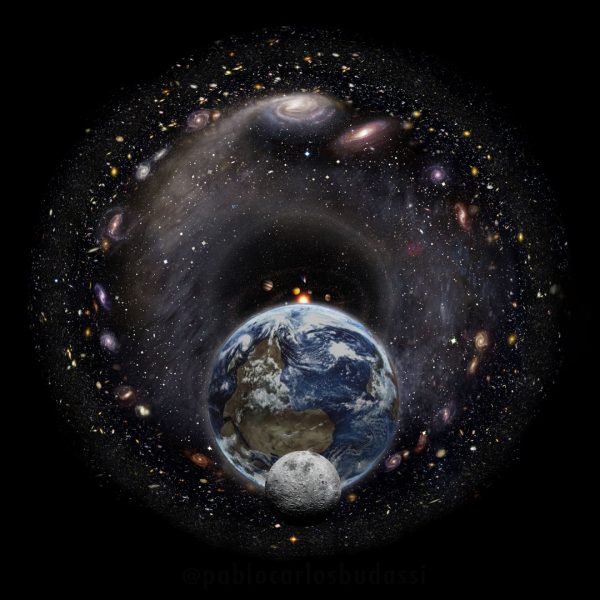
Still, the absence of evidence is not evidence of absence. Scientific discovery is constantly evolving, and what once seemed impossible often becomes reality with time.
Believing in aliens does not require abandoning logic or science. Instead, it reflects an openness to possibility and a recognition of how much remains unknown.
While we may not have all the answers yet, the vastness of space leaves room for wonder—and perhaps, one day, discovery.